
Can You Really Reverse Your Biological Age?
New Title
By Dr. Georgine Nanos, MD, MPH, Founder & CEO, Kind Health Group, Encinitas, CA
A patient came in recently thrilled and a little panicked. A direct-to-consumer test had told her that her biological age was eleven years older than her birthday, and she wanted to know how to reverse it. It is a great question, and the honest answer is more interesting than either the hype or the dismissal. So let me walk you through what biological age actually is, how much to trust that number you paid for, and whether you can really turn it back.
What biological age is trying to measure
Your chronological age is just how many times the earth has gone around the sun since you were born. Your biological age is an attempt to measure how old your body actually is, how worn your systems are, compared to that calendar number. It is a genuinely useful idea. Two women who are both 52 can be in very different places biologically, and we have all met them.
The most common consumer tests estimate this using epigenetic clocks, which read chemical tags on your DNA that change in patterns as you age. The science behind them is real and the Nobel-adjacent research is legitimate. The problem is not the concept. The problem is what happens when you try to put a single, precise number on one person.
How much to trust the number
Here is what the research actually shows, and it is the part the test companies tend to skip.
Epigenetic clocks are reasonably good at the population level. Across thousands of people, they can tell you that one group is aging faster than another. For you, individually, they are noisy. When researchers ran the same sample through several of the leading clocks more than once, the readings differed by as much as nine years from technical variation alone, before anything about your actual health changed. Newer versions narrow that, but the point stands: a single reading is a soft estimate, not a precise verdict.
The readings also move with short-term things, a recent meal, a bad night of sleep, stress, even altitude. So the eleven-years-older result that scared my patient could look meaningfully different next month without her doing anything. That does not make the tests useless. It makes them something to interpret carefully, as a trend over time rather than a number to panic about once.
Can you actually reverse it
This is where honesty matters most, because the marketing has run far ahead of the science.
The most cited human study claiming reversal was tiny, a handful of men given a combination of medications, and even there the number rose before it fell, and the clock was tied to a company with a commercial interest. Other studies describe interventions like certain diets slowing the pace of epigenetic aging, which is not quite the same as turning your body's clock backward. And because biological age has no true ground truth to check against, these clocks are a proxy, which means a reading that goes down is not proof that you are younger. It is proof that a proxy moved.
So the real answer is this. Can you change the things that drive how you age? Absolutely, and dramatically. Can a consumer epigenetic test prove you reversed your biological age? Not reliably, not yet, not from a single number.
What I pay attention to instead
The irony is that the levers that actually slow aging are the ones we can measure well and have measured for decades. Your blood pressure. Your metabolic markers and insulin sensitivity. Your muscle mass and strength. Your cardiorespiratory fitness. Your inflammation. Your sleep. These are not glamorous, and they do not come with an app telling you a single dramatic number, but they are real, trackable, and they respond to what you do.
At Kind Health Group, if you want to understand how you are aging, we look at those directly, the markers with ground truth and decades of evidence, and we track them over time. A biological age test can be a fun data point and even a motivating one. It should not be the thing steering your decisions, and it should never be the thing that frightens you into a purchase. The version of longevity that works is less sexy than a number, and far more reliable.
Frequently Asked Questions
Is a biological age test accurate?
At the population level, reasonably. For one individual, it is noisy. When the same sample was run through leading epigenetic clocks more than once, readings varied by up to nine years from technical variation alone, and they also shift with recent meals, sleep, and stress. Treat a single result as a soft estimate and a trend over time, not a precise verdict.
Can you actually reverse your biological age?
You can strongly influence the things that drive aging, but a consumer test cannot reliably prove you reversed your biological age. The main human study claiming reversal was very small and commercially linked, and because biological age has no true reference to check against, a clock reading that drops is not proof you are biologically younger. The lifestyle levers are real; the single-number proof is not.
Are epigenetic clocks legitimate science?
The underlying research is real and well regarded. Epigenetic clocks measure genuine age-related changes to DNA and work well across large groups. The limitation is precision for a single person at a single moment, which is different from saying the science is fake. The concept is sound; the consumer-level certainty is overstated.
What actually slows aging?
The measurable, well-validated markers: blood pressure, metabolic and insulin markers, muscle mass and strength, cardiorespiratory fitness, inflammation, and sleep. These respond meaningfully to how you live, they have decades of evidence, and they can be tracked reliably over time, which is more than any single biological age number can offer.
Should I pay for a biological age test?
It can be a fun and even motivating data point, but it should not steer your health decisions and it is not worth panicking over. If your goal is to understand and improve how you are aging, your money and attention are better spent measuring and moving the validated markers above, ideally with a physician who tracks them over time.
Related reading: why some women age faster than others and the only 5 things that actually extend human life.
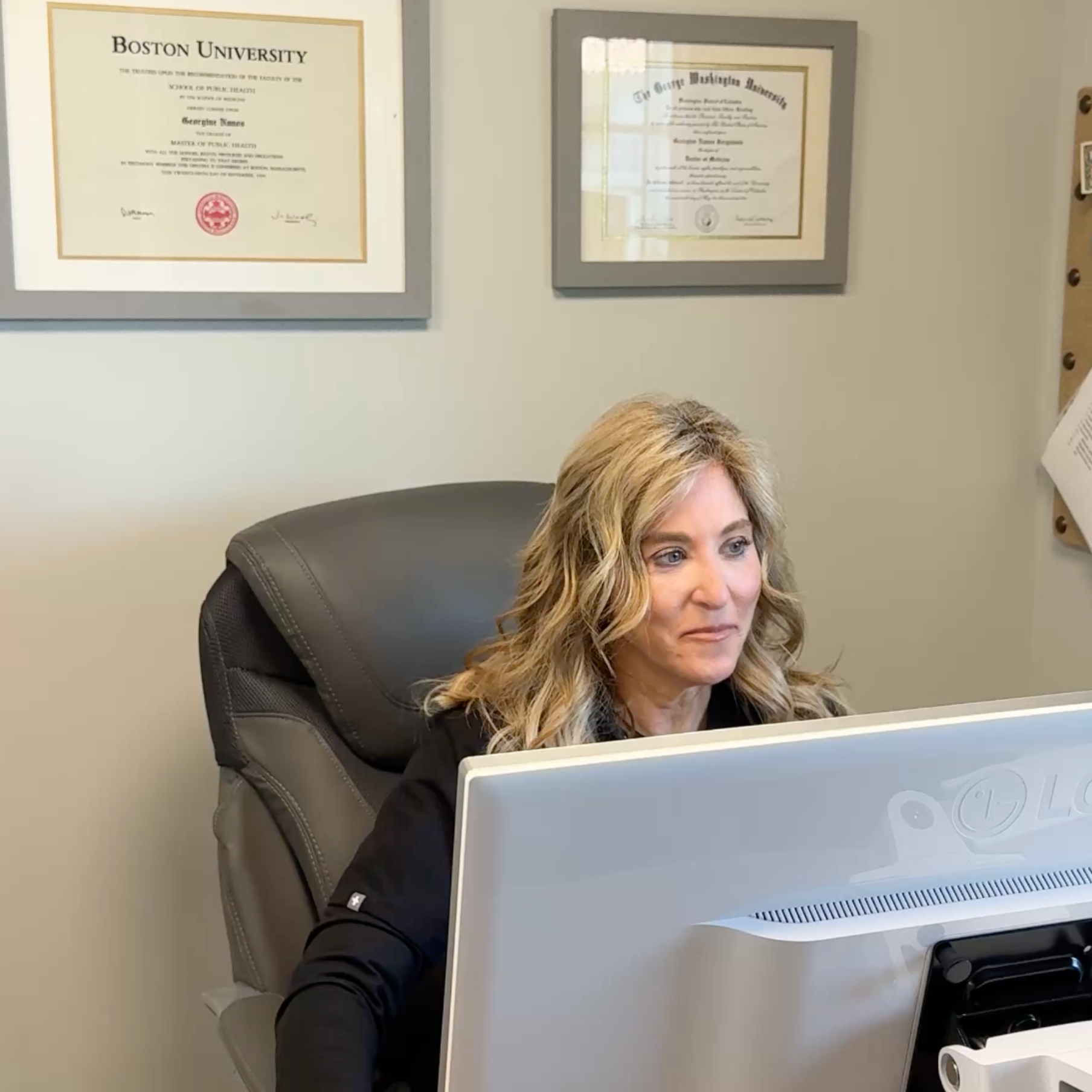
Dr. Georgine Nanos is a board-certified family physician and the founder of Kind Health Group in Encinitas, California, where she practices comprehensive concierge and preventive medicine for women in midlife.
New Paragraph
Meet the Author

You might also enjoy: