

Binaural Beats and Your Midlife Brain
March 5, 2026
What's Actually Happening When Two Tones Shift You Into Focus
You've probably seen the videos. Put on headphones, play a specific frequency, and suddenly you're focused, calm, locked in.
It sounds too simple to be real.
But here's the thing — there's actual neuroscience behind it. And once you understand what's happening in your brain, it stops sounding like a wellness trend and starts making sense.
Your Brain Runs on Rhythm
Most people think of the brain as a chemical organ. Serotonin, dopamine, cortisol — that's the language we've all learned.
But your brain is also electrical.
Right now, billions of neurons are firing in coordinated patterns — brainwaves — that directly shape how you think, feel, and function. These aren't metaphorical. They show up on EEG. They're measurable.
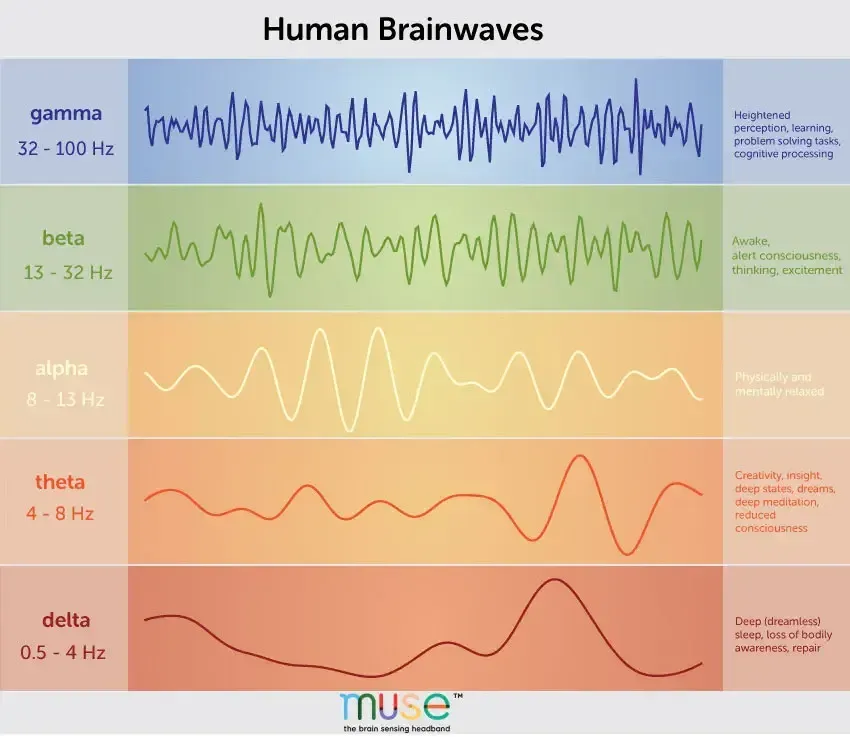
And different frequency states produce completely different experiences:
Delta (0.5–4 Hz):
Deep sleep. The restorative kind that so many of my patients haven't had in years.
Theta (4–8 Hz):
That dreamy space between awake and asleep. Also the frequency your brain uses to consolidate memory and process emotion.
Alpha (8–13 Hz):
Calm, open awareness. Present but not pressured. This is the state most people describe when they say they feel "like themselves."
Beta (13–30 Hz):
Active thinking. Problem-solving. The sharp, focused mode you need for work, decisions, conversations that matter.
Gamma (30+ Hz):
Peak performance. Heightened perception. Moments of insight where everything clicks.
When your brain is healthy, it moves between these states effortlessly. You focus when you need to. You rest when it's time. You're present at dinner instead of spiraling through tomorrow's to-do list.
When your brain gets stuck — from chronic stress, depression, hormonal shifts, burnout, poor sleep — those transitions stall. And what you feel is the fog. The scattered thinking. The "why can't I concentrate on anything" frustration.
That's not a discipline problem. That's a brain rhythm problem.
How Binaural Beats Actually Work
Here's where it gets interesting.
When you play two slightly different sound frequencies into each ear — say 200 Hz in one ear and 210 Hz in the other — your brain does something remarkable. It creates a third tone, pulsing at the difference between the two. In this case, 10 Hz.
That 10 Hz tone doesn't exist in the outside world. Your brain manufactures it.
This happens in your brainstem, at a structure called the superior olivary complex — the first place that processes sound from both ears at once. It detects the difference between the two frequencies, generates the beat internally, and sends that signal up through the brain.
And here's the key part: your brain doesn't just hear the beat. It starts to sync with it.
This is called entrainment. Your neural oscillations begin matching the rhythm of that perceived beat.
Play a 10 Hz binaural beat? You're encouraging alpha waves — calm, present awareness.
Play a 40 Hz beat? You're nudging toward gamma — sharp, high-level thinking.
Play a 6 Hz beat? You're promoting theta — deep relaxation and memory processing.
Think of it like this: your brain naturally wants to follow a rhythm. It's why your foot taps to music. It's why your breathing syncs with a song's tempo without you trying. Binaural beats use that same tendency — just targeted to specific brainwave frequencies.
What the Research Says (Honestly)
I'm going to give you both sides here, because you deserve accuracy — not hype.
Where the science is strong:
A 2025 study in *Scientific Reports* used EEG on 80 participants and confirmed binaural beats produce real, measurable brainwave entrainment. Your brain genuinely synchronizes. Gamma frequency beats improved general attention performance — but only with the right parameters. Frequency, carrier tone, and background noise all mattered.
A 2024 study showed that daily 10-minute sessions of 6 Hz binaural beats over one month increased P300 amplitude — a marker of cognitive processing speed and attention. And the effect built over time, suggesting real neuroplastic adaptation. Not just a momentary shift.
A 2025 meta-analysis pooling 15 randomized controlled trials found binaural beats significantly reduced anxiety and pain in surgical patients — outperforming placebo audio in direct comparison.
Where it gets complicated:
A 2023 systematic review of 14 studies found inconsistent results across the board — five supporting entrainment, eight contradicting it. The problem? Wildly different methods. Different frequencies. Different session lengths. Different everything.
The takeaway:
Binaural beats are not a miracle. They're also not nonsense.
They're a real phenomenon with real brain effects — but the details matter enormously. A random YouTube track is not the same as carefully designed audio with the right frequency, carrier tone, and parameters.
This tracks with everything I know about brain stimulation. It's never just about whether
you stimulate the brain. It's about how. We learned this with TMS protocols — the shift from generic stimulation patterns to ones that mimic the brain's natural rhythms changed everything. The same principle applies here.
Precision matters. Your brain responds to specificity.
Why This Matters to You
If you've been dealing with brain fog, scattered thinking, trouble concentrating — and you've been blaming yourself for it — stop.
Your brain operates on electrical rhythms. When those rhythms get disrupted — by stress, by hormonal changes, by depression, by simply running on empty for too long — focus doesn't just feel hard. It IS hard. Neurologically hard.
You're not lazy. You're not losing it. Your brain is stuck in the wrong gear.
Binaural beats won't cure depression. They won't replace medical care. But they can be one accessible, low-risk way to support your brain's ability to shift into the frequency state you need — whether that's focus, calm, or rest.
Why This Is Especially Important for the Midlife Brain
If you're a woman in your late 30s, 40s, or 50s and your brain suddenly feels like it's running on dial-up — this section is for you.
Estrogen isn't just a reproductive hormone. It's a brain hormone. It keeps neurons healthy and helps them communicate. It supports serotonin, dopamine, and acetylcholine — the chemicals that control mood, attention, and memory.
It enhances blood flow to the brain. It protects against inflammation. It supports neuroplasticity, your brain's ability to adapt and change.
During perimenopause — which can start in your early 40s, sometimes even your late 30s — estrogen doesn't just decline. It swings. Sky high one week, crashed the next. And your brain feels every single swing.
When progesterone drops alongside it, you lose its calming effect on GABA — the neurotransmitter that keeps your nervous system from running in overdrive. So now you've got erratic estrogen tanking your focus and memory, low progesterone fueling anxiety and insomnia, and a brain that's lost the neurochemical support system it relied on for decades.
Most women are told it's "just hormones" or "normal aging." I hear this constantly. And it drives me crazy because it's dismissive, it's incomplete, and it leaves women believing they've permanently lost a step.
You haven't.
Your brain is struggling because the inputs changed — not because the hardware is broken.
And this is exactly where tools like binaural beats become relevant for the midlife brain.
When your neurochemistry is shifting, your brain's ability to transition between frequency states gets disrupted. You get stuck in the fog of theta when you need beta sharpness. You can't settle into alpha calm because your stress response is overactive. Your sleep suffers because you can't drop into delta.
Binaural beats offer a non-hormonal, non-pharmacological way to gently support those transitions. They won't replace hormone therapy if you need it. They won't fix a thyroid problem or treat clinical depression. But they can be a daily practice that gives your shifting brain a rhythm to follow — a reference point when your internal signals are in flux.
I see this as part of a comprehensive approach. Hormones, sleep, nutrition, stress management, and when needed, neuromodulation like TMS to restore the brain's deeper circuitry. Binaural beats fit into that picture as an accessible tool you can use at home, on your own terms, starting today.
Because your midlife brain isn't declining. It's adapting to a massive neurochemical shift — and it deserves support, not dismissal.
If You Want to Try It
Pick the right frequency for your goal.
Beta (14–30 Hz) or gamma (40 Hz) for focus. Alpha (10 Hz) for calm alertness. Theta (4–7 Hz) for relaxation and winding down.
Use headphones.
Non-negotiable. Binaural beats only work when each ear gets a different frequency. Speakers won't create the effect.
Give it at least 10 minutes.
Entrainment doesn't happen instantly. Research shows 7–10 minutes is typically when your brain starts syncing. Fifteen to thirty minutes is the sweet spot.
Be consistent.
The study showing lasting cognitive changes used daily sessions for a month. Like most things that genuinely change your brain, consistency matters more than intensity.
Be selective about your source. Not all binaural beats tracks are the same. The research is clear: parameters matter. Look for audio designed with specific frequencies and carrier tones, not generic ambient tracks labeled "focus music."
The Bigger Picture
Binaural beats are one tool. A genuinely interesting, science-backed tool.
But what excites me most about this research isn't the beats themselves. It's what they prove about your brain.
Your brain is not static. It responds to stimulation. It adapts. It synchronizes. It can be gently guided back toward healthy, functional patterns.
That's neuroplasticity. And it's the same principle behind everything we do in brain health — from binaural beats to neuromodulation to the comprehensive care approach we take at Kind Health Group.
If you've been told to just push through the fog, to try harder, to wait it out — you deserve to know that your brain is asking for help in a language most doctors never learned to speak.
You're not broken. Your brain just needs the right input.
And that changes everything.
---
Dr. Georgine Nanos is a board-certified physician with over 20 years of experience integrating brain health with comprehensive primary care at Kind Health Group in Encinitas, California.
Meet the Author

You might also enjoy:

Dr. Georgine Nanos sits down with Kyle Hartfield, founder of iTalk TMS, a patient-facing advocacy platform he built because he could not stand a minute of the existing content about it.

Painful sex and dryness after menopause are treatable. Dr. Nanos on Mona Lisa Touch, the non-hormonal laser for vaginal atrophy. KHG, Encinitas CA.
Dr. Georgine Nanos sits down with Dr. James Ross, who practices what he prefers to call holistic brain health.
Colorectal cancer is climbing 3% a year in adults under 50, and younger patients are nearly twice as likely to be diagnosed at stage 4. A UC San Diego surgeon on why, and the two words that fix most of it.